Serene. Tranquil. Beautiful. Sublime. Iconic. Extraordinary. Nothing – nothing! – comes close to doing justice to the wonderment one encounters when in the hallowed presence of the phenomenon called Lake Bled in Slovenia. Nature and man have combined to create, conjure and contrive a vista, an experience that one lives and breathes and savours upon introduction. The multi-faceted delights of Lake Bled quicken the pulse, melt the heart and mist the eyes of even the most cynical, road weary traveler fortunate enough to be granted an audience with this majesty, to witness these treasures in this most regal of courts.
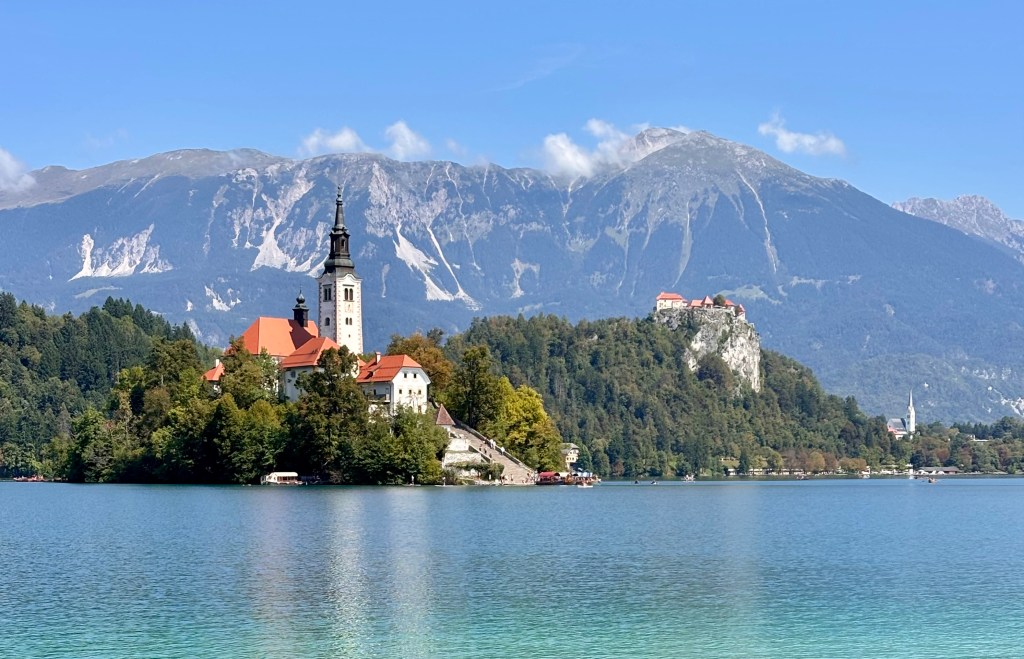
Many times, in my travels around the world, I’ve encountered a scene so perfect, so lovely and calming that I’ve wanted to wrap it up and preserve it for eternity. Lake Bled at 6.30am in August was such a time. My brother Jim and I were staying at the Hotel Triglav above the lake and, not for the first time, I was awake before him. I opened the skylight in our room and in the milky blue twilight Lake Bled was right there below me, unblemished, unruffled and utterly mesmerizing. And then the church bells began to chime! From the Church of the Assumption of the Blessed Virgin Mary
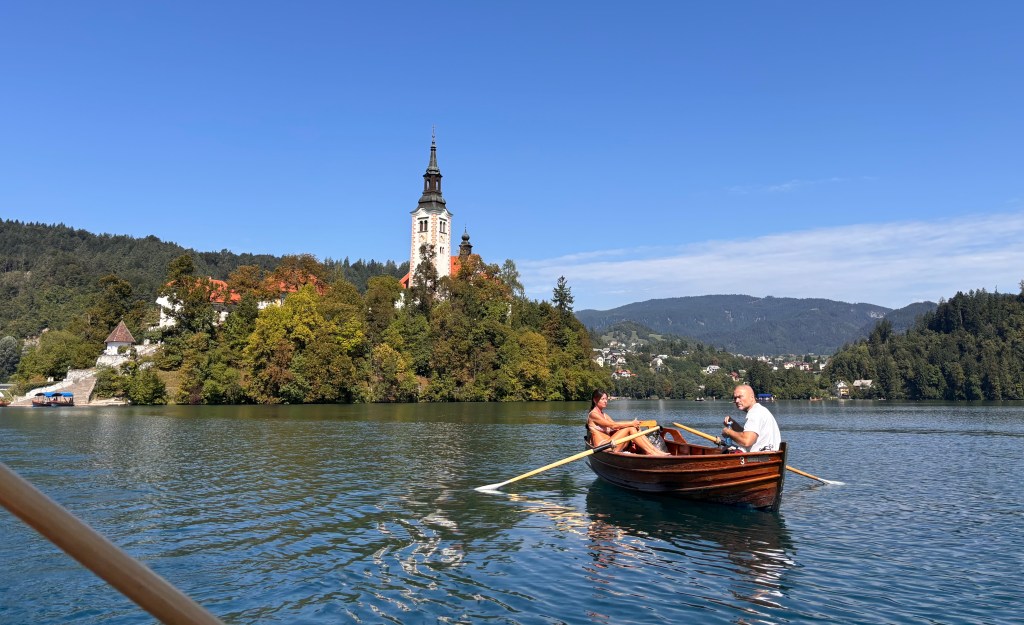
on Bled island on the lake! It was idyllic and fragile and I needed to be out there. Right now! Just 200 yards from our hotel was the quiet train station (with a station bar out front!) and opposite the train station was the pathway down to the lake. Hotel Triglav was not only very comfortable in an old European antique way, but it was perfectly located too. With a little cajoling, my brother was up and ready for what proved to be a memorable day. We walked down the path and through the Olympic Rowing Centre and were down at the water’s edge a little after 7am. There was barely a soul about, the only sound the wind whispering through the trees above, creating tiny fractures in the mirror lake perfection of Lake Bled. Heading from the shore to the island, an armada of ducks nudged the still waters aside, leaving perfect crescents in their wake. A lone fisherman on a wooden jetty cast his line languidly. A runner passed by, crunching the gravel as he went. The distant Julian Alps, green and majestic, paid silent witness as Lake Bled was awakening. Morning was broken and, sans caffeine and in awe of the surreal beauty in front of us, we began our somnambulant trek around the lake. The six-kilometer trail is perfect for walking, running or cycling as it is wide and level and in excellent condition. The lake is fringed by beech, oak, silver birch and maple trees which sporadically will draw their curtains in front of the view of the Blejski Otok island and the church, but this does make for enticing opportunities to compose nice pictures.

Remnants of Bled Island history go as far as the 11th B.C. A Slavic settlement was established from the 9th to the 10th century at the site of the present church and foundations of a pre-Romanesque chapel, built during the spreading of Christianity, also date to that period.
The first brick-built church on the island was consecrated in 1142 by the Aquileia patriarch Pellegrino and rebuilt in Gothic style in the 15th century; the renovated church was consecrated in 1465 before it was damaged in 1509 by an earthquake.
There had been a distinct chill in the clear, early morning air when we started out but as we headed clockwise round the lake we slowly warmed up. We passed delightful lakeside villas with balconies and decks and waterfront gardens and soon we were under the austere gaze of Bled Castle perched high above us on a severe and steep limestone cliff face, its pale walls fringed by dark orange tiled roofs. Built in 1011, Bled Castle was deeded to the bishops of Brixen and remained as the residence of the bishops for eight centuries, all the while keeping sentinel over Lake Bled. The castle buildings are arranged around two courtyards, which are connected with a staircase. There is a chapel in the upper courtyard, which was built in the 16th century. The castle also has a drawbridge over a moat as James and I would discover the following day when we toured the castle.
Our circumnavigation of the lake continued, and we passed the pretty St. Martin’s Parish Church standing proud like a pristine white stalagmite in the ethereal early morning light. We took a break at the almost waterfront Kult Pub where the shenanigans of last night’s revelry still hung heavy in the air; a not unpleasant mix of cigar smoke, perfume and liquor all burnished by the incongruous thumpity-thump of house music at 8am. Billie Holiday would have suited my pre caffeinated desire for peace and solitude better but we were very pleasantly surprised by friendly service, hot and tasty ham and cheese croissants and cappuccinos strong and hot enough to wake the dead.
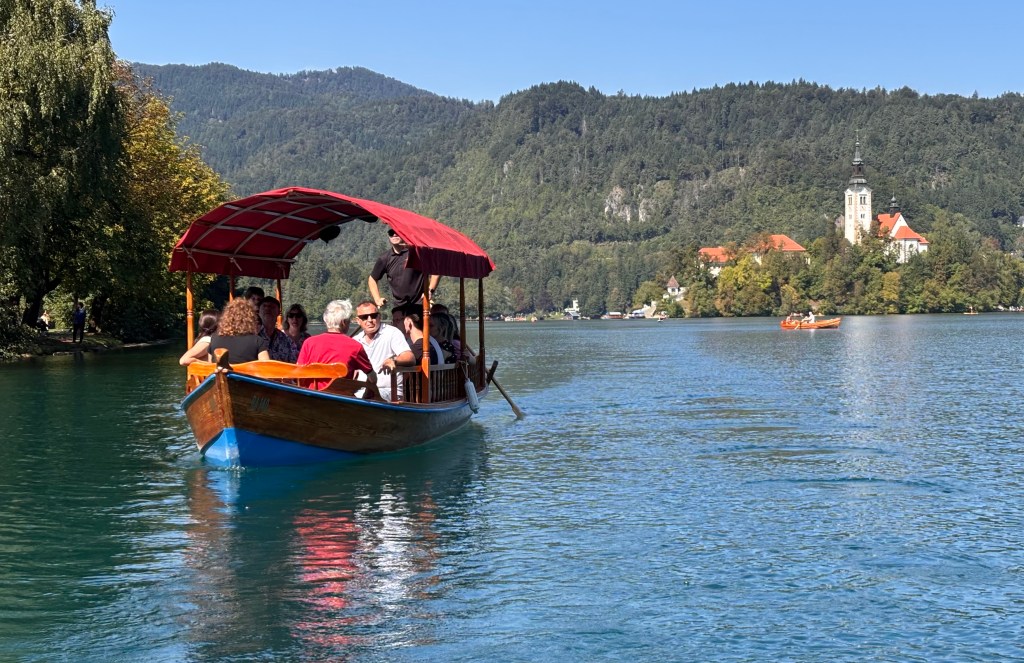
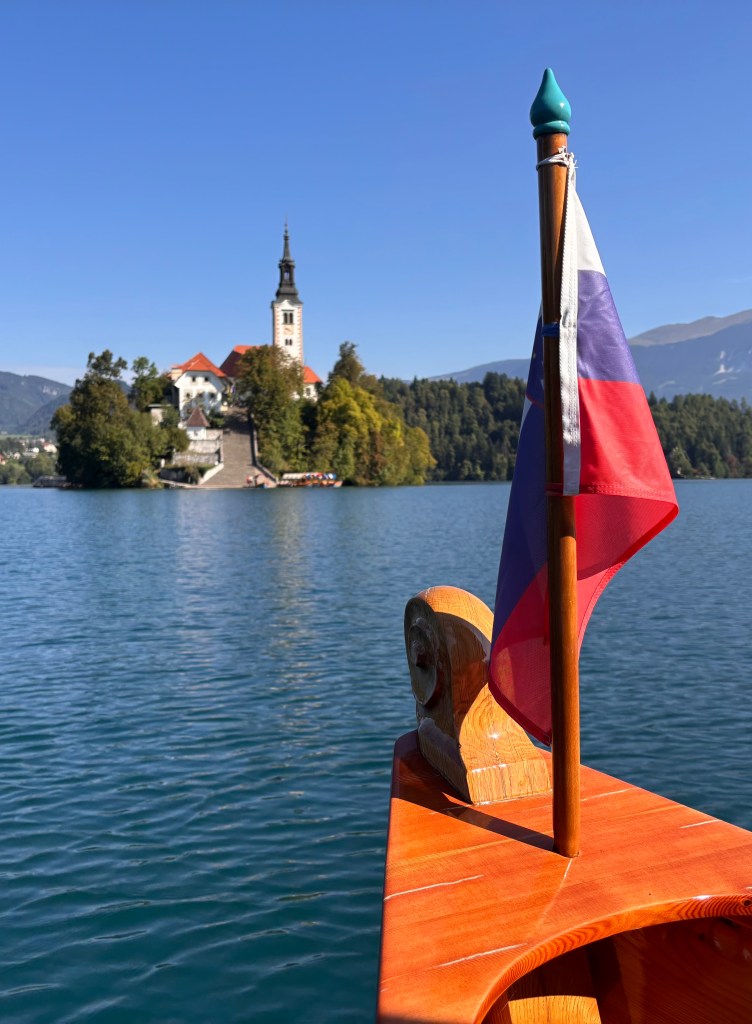
It was now time to join an iconic Pletna boat for the ride out to the island. There are 23 wooden Pletna boats on Lake bled and this is the only place they are found in the world. A Pletna, borrowed from the German for ‘flat-bottomed boat’, can seat 20 people under a colorful canopy and are steered by a standing oarsman. The fare is 20 Euros per person and includes a 45 minute stop on the island to explore the essential Church of the Assumption of the Blessed Virgin Mary. Jim and I resisted the offer to climb the tower and ring the bell and instead we gazed out onto the perfect blue of the lake, it’s pristine early calm being disturbed and fragmented as other Pletnas, row boats, and swimming groups headed out to surely one of the most sensational spots on the planet. We walked around the tiny island, took pictures, and I bought a couple of historic postcards showing a horse and sleigh in front of the island when the lake used to regularly freeze over! It was truly a special moment, and we agreed we were very privileged to be ‘right here, right now’. Enchanted and grateful, we met our Pletna oarsman for the trip back to shore, craning our necks and photographing greedily as this majestic and essential sight receded from view.
As a self-confessed coffee snob and history buff, the lofty Café Belvedere was an absolute must see for me. Perched high on pillars above Vila Bled, Café Belvedere was designed by the famous Slovenian architect Jože Plečnik as the ‘waiting room’ for audiences of the Yugoslavian King Alexander. Famously, the Yugoslav president Josep Broz Tito hosted members of royalty, presidents and famous people at tea parties with cognac and cigars. The bleak furnishings and historic black and white photographs within these austere, communist era walls, add immensely to the atmosphere. And then there’s the view. The View! Jim and I had a table out on the balcony overlooking Bled island and, at that very moment, there was nowhere else on the planet we’d rather have been. We ordered two more excellent cappuccinos and two large slices of famous (notorious?!) Bled cream cake, or kremna rezina. It’s a local specialty made with a flaky puff pastry base, rich vanilla custard, and whipped cream, all dusted with powdered sugar. The original recipe was created in 1953 at the nearby Hotel Park. We’d almost completed the six-kilometer tour of the lake and the steep steps up from the gravel path to the café itself and so we felt virtuous enough to indulge generously.
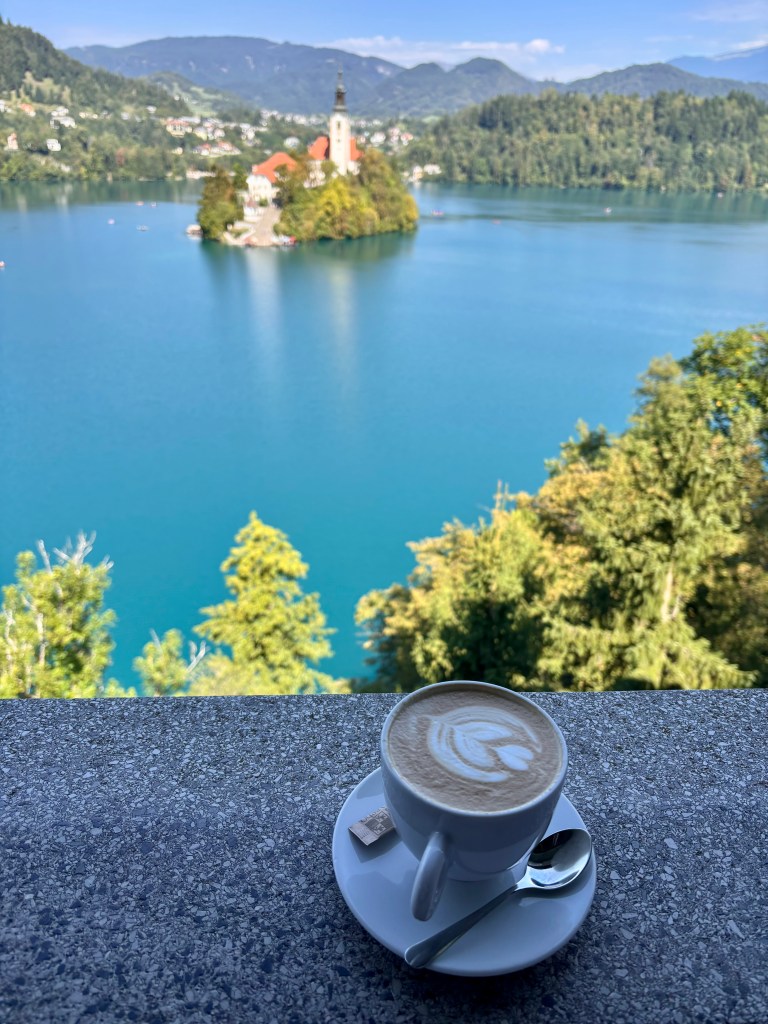
We headed back to Hotel Triglav and then back down to the popular grass area by the Rowing Center where we parked our towels and swam back out and around Bled island, a very enjoyable one-and-a-half-kilometer swim. Back on Terra Firma, under the gaze of the rowing center, our Hotel Triglav, Café Belvedere, the distant and jagged Julian Alps and Church of the Assumption of the Blessed Virgin Mary on the island, its bells again chiming and charming, we dozed contentedly in the late afternoon sun.
It had indeed been Beyond Belief. All of it! As we reluctantly left Bled excited for our three days stay on the Slovenian Riviera at Piran, we had, most certainly, Basked in the Beguiling Beauty of Lake Bled.
 One Step Beyond
Leave a comment